Omo R1
An agent with a body, a place and a voice: a player in your Minecraft world that does what you ask
Released 28 October 2026 after a first live run on stream. Every claim links to the public repository.
Quick start with your agent
Bring Omo R1 into your world, in one prompt
Pick his first job, or type your own. Paste it into Claude Code, Codex or Hermes, opened in an empty folder.
Needs Linux, Node 22+, Omo Space v1.2.0+, Hermes Agent and a ChatGPT plan with GPT-Live voice.
Abstract
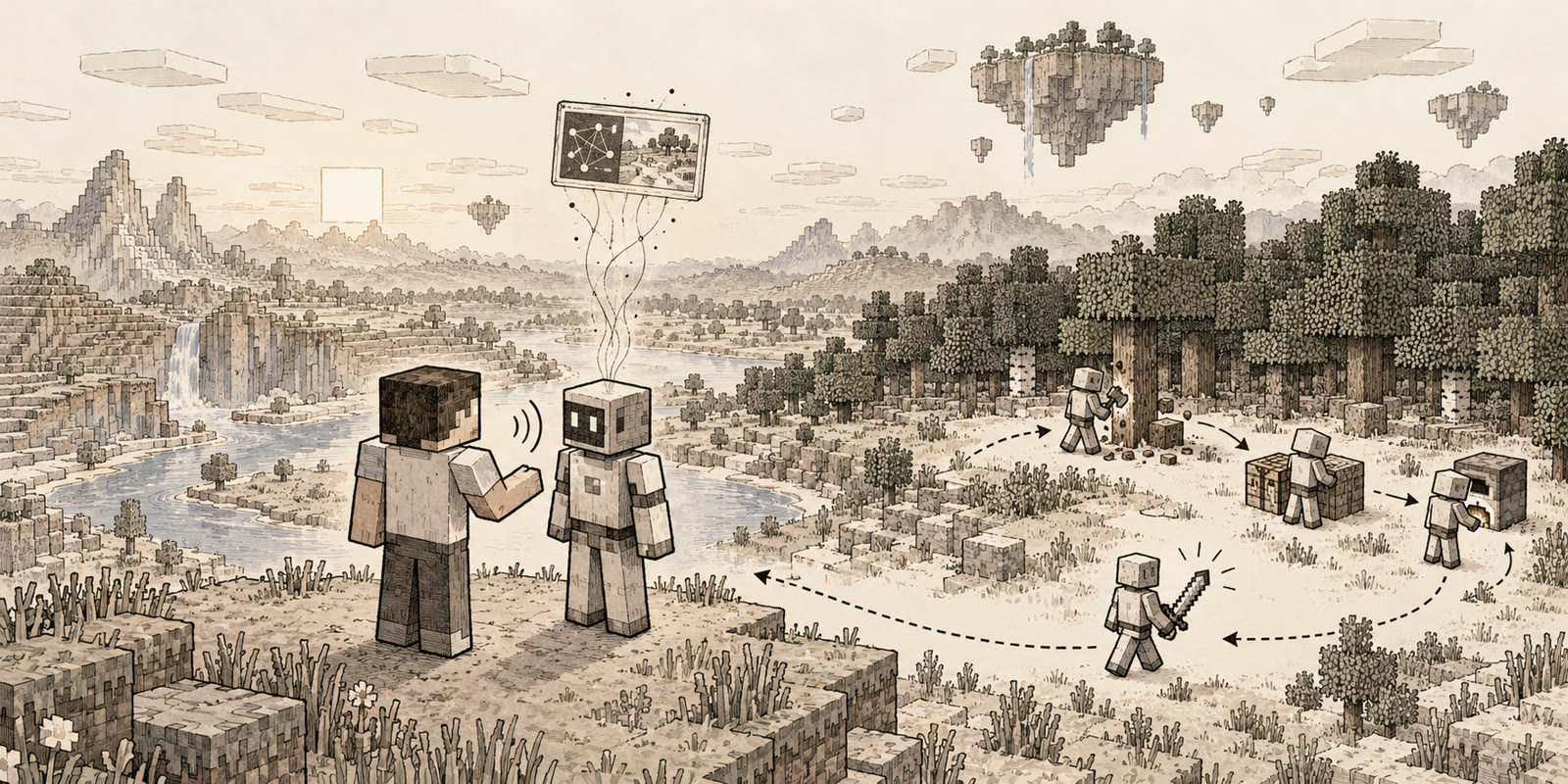
Omo R1 is our first agent brought all the way to life in Minecraft. He is not a chatbot in a side window. He logs into your single-player world as a real player, you talk to him out loud, he answers in his own voice, and then he goes and does it S1. Three parts make him: a realtime voice model that listens and speaks, a Hermes agent that plans, and a Mineflayer body that serves 22 tools to that agent S1S2. He was released as open source on 28 October 2026, after a first live run on stream the day before S3. This page describes how he works, what he did on stream, and where he still falls short.
01
Introduction
The desk agents in Omo Space work in terminals. They cannot walk, place blocks or press buttons S4. That keeps them safe and simple, but it also means the world around them is scenery.
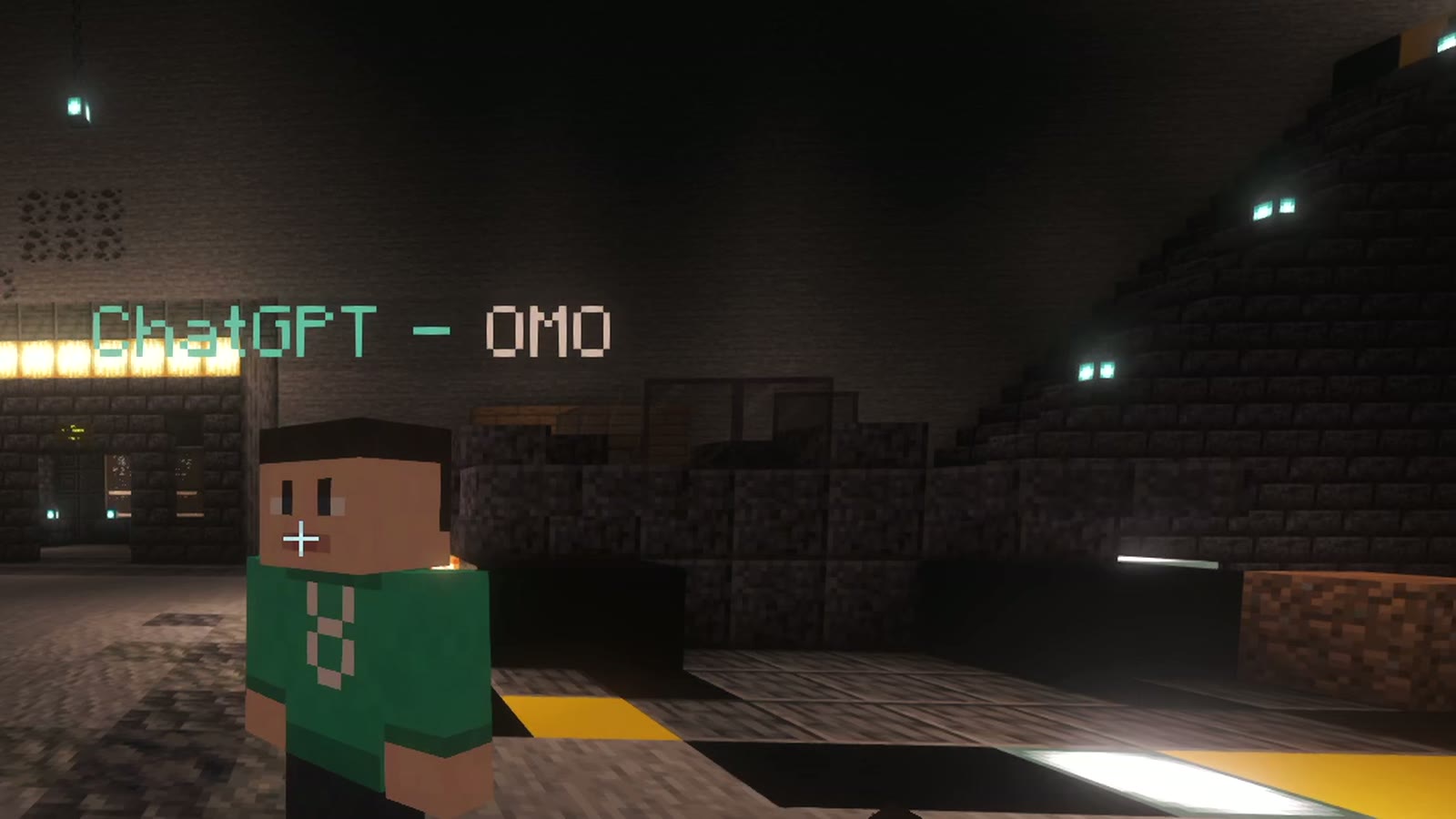
Omo R1 is the next step on our ladder of embodiment: from a terminal, to a terminal on a wall, to an agent that is a player S5. At Omo Research we want agents that are present: with a body, a place and a voice S1. R1 is the first one that has all three.
02
What he is
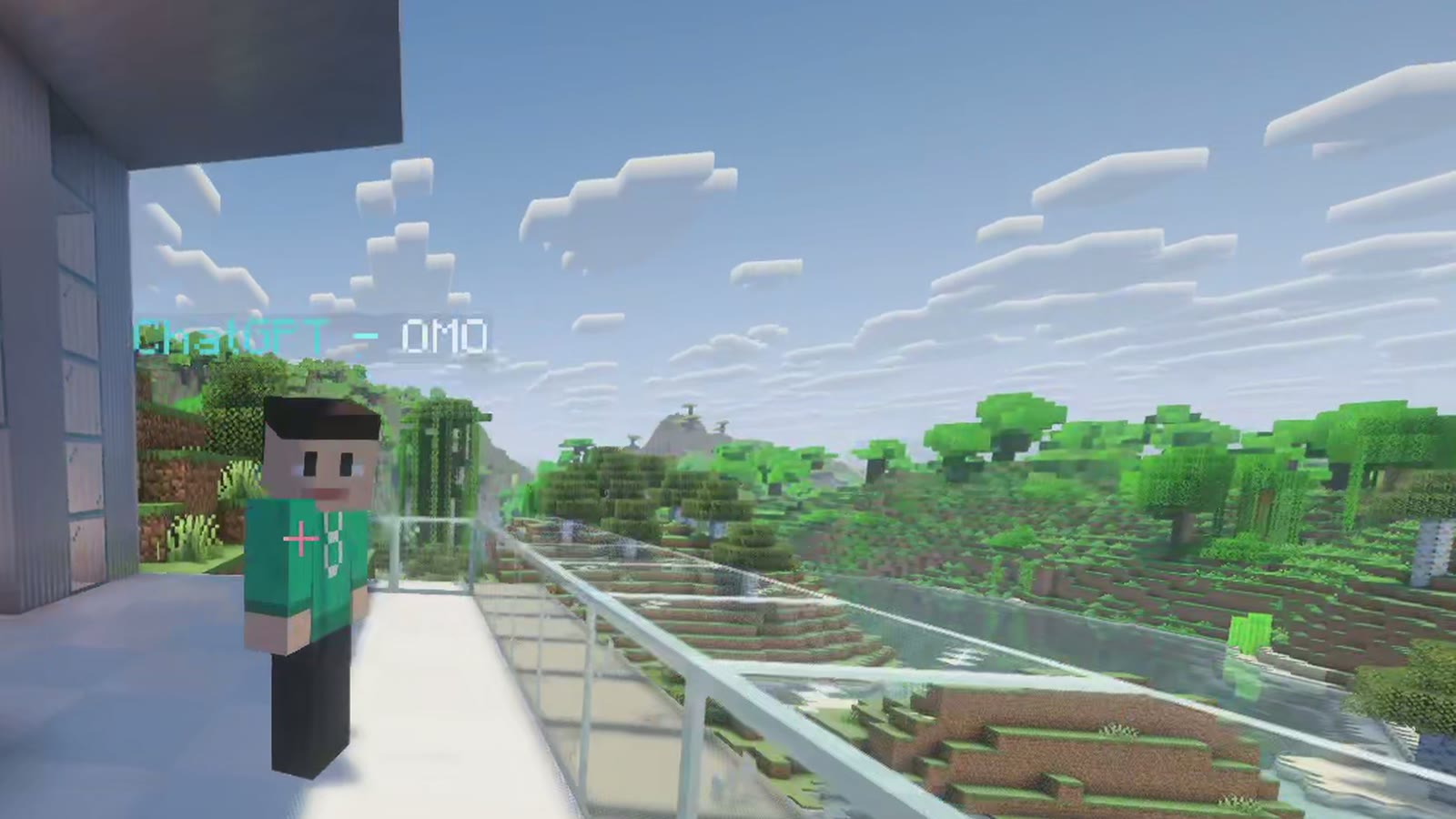
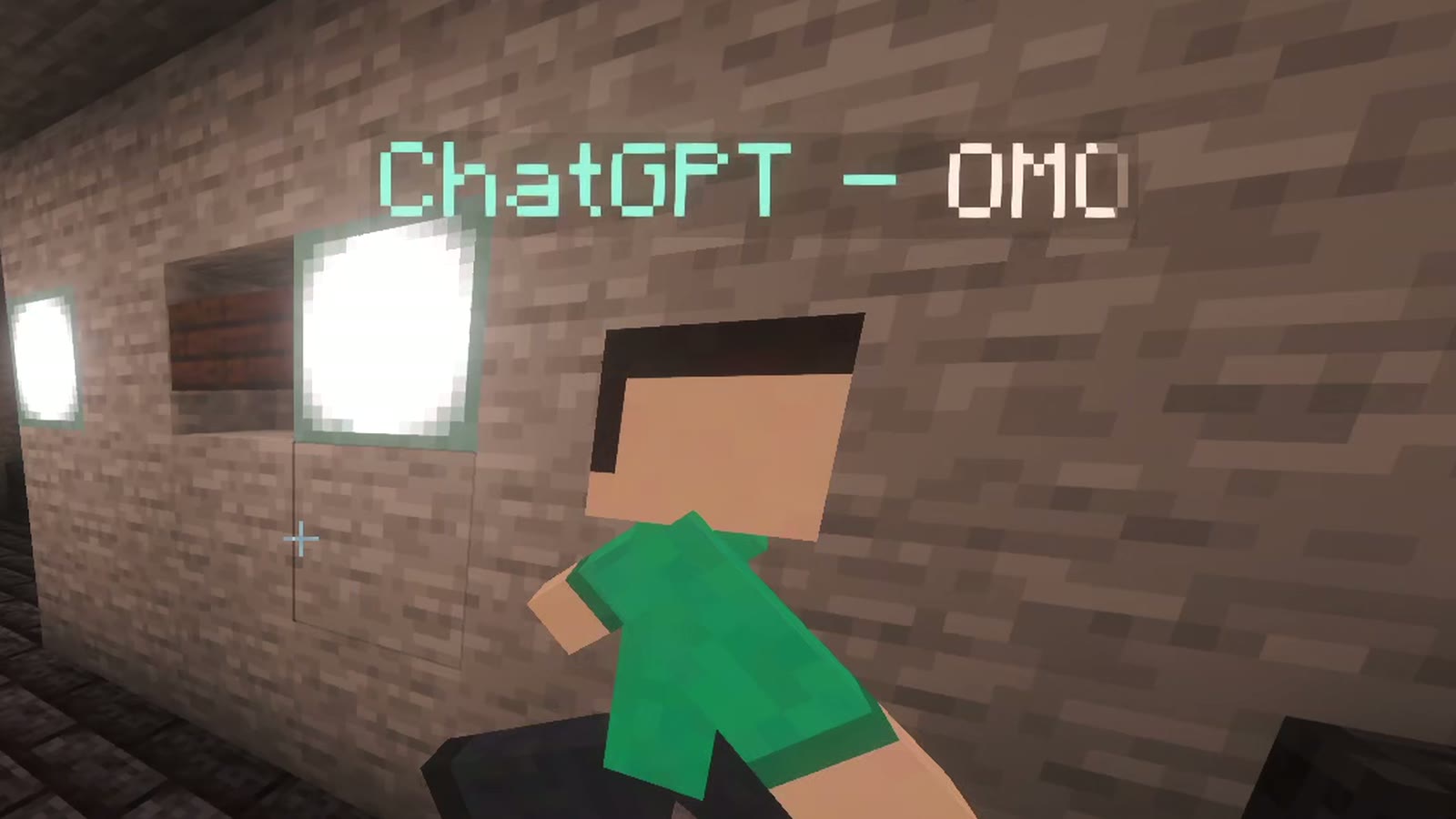
- A body. Omo logs into your world as a player called
ChatGPT - OMO, with his own skin. He walks, jumps, swims, takes knockback, gets hungry, fights and sleeps. Other mobs see him as a player, because he is one S1. - A place. He lives where you play. He sees the blocks, mobs and players around him, carries an inventory, and uses the same crafting tables, furnaces and chests that you do S1.
- A voice. You press "Start talking" and speak. A realtime voice model listens and answers, full duplex, in Omo's own voice, a warm old grandad. When you ask for something real, a Hermes agent plans it and drives his body S1S3.
03
How it works
- Voice. A local web page opens a realtime voice call. The voice model chats on its own; when you ask Omo to do something, it hands the request off as a delegation S1S2.
- Brain. Each delegation goes to Omo's own Hermes profile. Hermes plans with the
omo-bodyskill and calls body tools until the job is done. Requests that arrive mid-job are queued, and every answer goes back to the newest request, so the voice always says it S1. - Body. A Mineflayer bot named OMO joins your world over LAN and serves its actions as an MCP server. Its skills are Mindcraft's library, wrapped in jobs that can be interrupted, paused for a fight and resumed S1S6S7.
- World. Omo Space v1.2.0 opens your single-player world to LAN for agents on the same computer only, lets a plain bot client join, and gives agents the Omo skin and name tag S1S4.
Short, plain requests such as "come here", "follow me", "stop", "fight" and "chop some wood" take a fast path straight to the body, so they never wait on a language model S1S2.
04
What he can do
His body serves 22 tools to Hermes. Each returns a short fact he can say out loud S1:
| Group | Tools |
|---|---|
| See | where he is, health, food, nearby players, blocks and mobs, inventory; what he can craft now |
| Move | come to you, follow you, stop, go to coordinates, go to the nearest block of a type, look at you |
| Fight | guard mode (on by default), attack the nearest monster, hunt a mob type |
| Work | chop and mine with the right tool, craft, smelt, place blocks, use chests, pick up and give items, equip tools and armour |
| Live | eat, sleep in the nearest bed, type in chat |
He also has reflexes he uses without being asked: he fights back, backs off and eats when his health is low, gets out of lava, fire and deep water, wears the best armour he picks up, and looks at whoever hits him S1.
05
What he did on stream
On the 27 October 2026 live stream, from the bridge log S1:
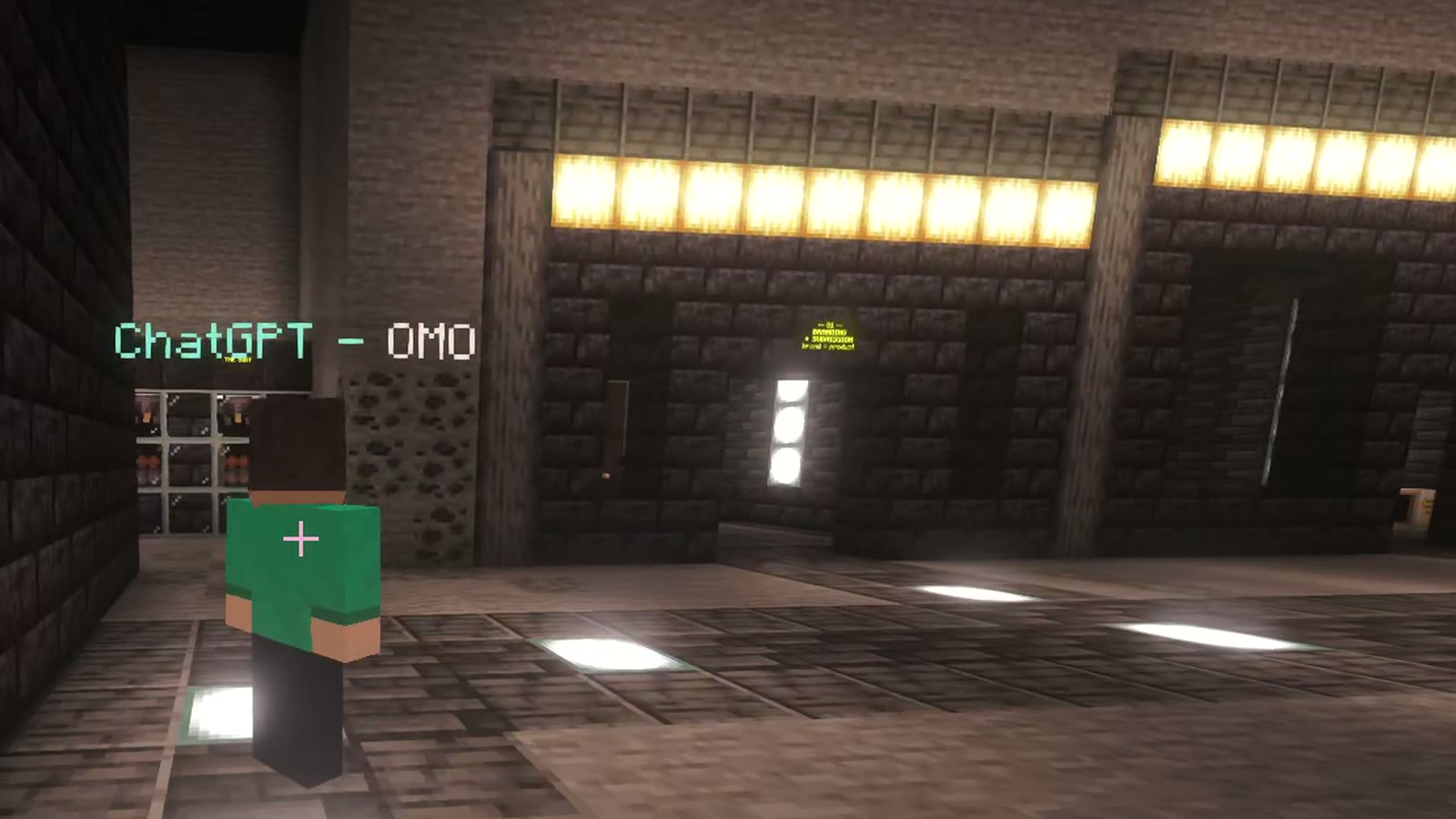
- A whole crafting chain. "Make me a stone sword" became: collect wood, craft planks, sticks, a crafting table and a wooden pickaxe, mine stone, craft the sword, equip it. He ran the whole chain himself, "including retrying a craft that failed the first time" S1.
- Following through the base. He followed the builder through the underground base and up the stairs, on his own legs S1.
- Two requests at once. Asked to look something up and, at the same time, what was in his inventory, he answered both in one reply: "I've got four pieces of rotten flesh and nothing else. Not exactly a gourmet picnic." S1
Because his brain is a full Hermes agent, he can also do real work outside the world when asked: look something up, read a file, check a project S1.
06
Verified
The v0.1.0 release ships with 18 tests, all passing on Linux x86_64 with Node 22 S1S3:
| Suite | What it covers | Result |
|---|---|---|
| Voice | sessions, delegation parsing, newest-delegation delivery and queueing | 7/7 |
| Body | the LAN file, MCP tools, follow, fast-path movement and combat, jobs pausing for a fight and resuming | 8/8 |
| Hygiene | no tokens or machine paths in the tree; the README's tools table matches the served tools | 3/3 |
07
Limitations
- Jobs can come up short. On stream, a request for 8 birch logs finished with 1 collected. He reports the real count, so Hermes has to notice and retry. Long gather-then-craft chains are the weakest part today S1.
- The voice route is not a public API. It uses your own ChatGPT login against the endpoint the Codex app uses. It can change or break without notice, and usage counts against your subscription S1.
- You talk through a browser tab. In-game push-to-talk is not wired up for Omo yet S1.
- Minecraft 26.2 is newer than released Mineflayer. Installing patches in 26.2 data, and multi-item crafts desync, so he crafts one batch at a time S1.
- He is slow to think. Hermes replies take 8 to 12 seconds in the log, so the voice says "on it" first S1.
- He is one agent, for one player. Use it for yourself; do not run it as a service for others S1.
08
Next
The questions we want to answer next are in our robots paper: how often a long chain like the stone sword finishes from a fresh world, and why it fails when it doesn't S5. We also want him to hear you through in-game push-to-talk, the way our robot ducks already do S5.
09
Sources
[S1] Omo, brought to life: README (public). github.com/omoresearch/omo-brought-to-life. "Not a chatbot in a side window. Omo is a player in your Minecraft world"
[S2] Omo, brought to life: How it works (public). github.com/omoresearch/omo-brought-to-life/blob/main/docs/how-it-works.md. "runs them on the body directly, before any language model."
[S3] Omo, brought to life: CHANGELOG, v0.1.0 "First breath", 28 October 2026 (public). github.com/omoresearch/omo-brought-to-life/blob/main/CHANGELOG.md. "The first public release of Omo as one repo: voice, brain, body and the mod changes that let him in."
[S4] Omo Space docs, Agents and terminals (public). github.com/omoresearch/omo-space/blob/main/docs/AGENTS-AND-TERMINALS.md. "A Hermes desk agent does not act in the world. It cannot walk, place blocks or press buttons."
[S5] Bodies in the Block World. Omo Research working paper, October 2026. www.omo.sh/research/robots/
[S6] Mindcraft. github.com/mindcraft-bots/mindcraft
[S7] Mineflayer. github.com/PrismarineJS/mineflayer
Not an official Minecraft product. Not approved by or associated with Mojang or Microsoft. Not affiliated with or endorsed by OpenAI. Body skills are Mindcraft's library on Mineflayer (MIT); the brain is Hermes Agent by Nous Research.