← Research
Rooms, Not Windows
← Omo Research
Omo Research · Field study

Rooms, Not Windows

Spatially Aware Creative Agentic Interfaces

Omo Research·October 2026
Working paper · draft
Scroll
In short

One person now runs ten or twenty AI agents at once. A chat window was never built for that.

We gave every agent a place: a desk in a Minecraft world, with its screen on the wall and a lamp that shows whether it is working. Then we lived in it for five days, live on stream.

Four everyday chores of managing agents turned into things people already do well: finding became walking, resuming became coming back, monitoring became glancing down a hallway, and orchestrating became walking a pipeline of rooms. A lot also broke, and we show that too.

Honest caveat: this is one builder plus one second user, with no comparison group. These are design findings and testable ideas, not proven effects.

29 hof live streams read, start to finish
21–25agent sessions running at once, at peak
791quotes checked word for word against the transcripts
2people: the builder and one second user
The idea in one walk

From a pile of tabs to a building you can walk through

Keep scrolling: the picture changes as you read.

one agent, one chat: fine twelve agents, twelve tabs ? which one is waiting for you? HALLWAY “build me a robotics lab” you game closed · PC off overnight walk to the room you remember the work kept going while you were away one glance: gold working · green idle · red needs you a video walks the pipeline; you approve at the end
The old way

One agent, one chat window

For a single assistant, a chat box works. You ask, it answers, you read.

The problem

Now there are twelve

Agentic work means many agents that keep running for hours. Each gets a tab. Every tab looks the same.

The problem

Which one needs you?

You lose track of three simple things: which agent is which, which is working, and which is waiting for you.

“Nobody remembers which of the 12 terminal tabs are doing what”Stream, 28 Oct · 07:14
The idea

Give every agent a place

Each agent gets its own room, with a desk, a screen on the wall and a lamp. Rooms sit side by side along a hallway, like stages of your work.

“But what if we gave a room to everything?”Stream, 25 Oct · 00:38
Move 1 · Find

Walk to it

You don’t search a list. You remember the requirements room is the third door, and you walk there.

“How do you keep track of your agents? I just walk around”Stream, 28 Oct · 09:00
Move 2 · Resume

It’s where you left it

Close the game, switch off for the night. The agents run on your PC, not in the game, so their work carries on. When you come back, every screen is where it was.

“Boom the agents are still working right here”Stream, 25 Oct · 02:12
Move 3 · Monitor

Look down the hallway

Lamps tell you the state of the whole team from the doorway. No tab-checking: the red one needs you.

“Now you can see your whole team from the hallway.”Stream, 28 Oct · 00:39
Move 4 · Orchestrate

Walk the pipeline

Each room is one stage of a job: ideas, references, requirements, editing, publishing. Work moves room to room; you approve at the end.

“This video went through all five rooms before you saw it.”Stream, 28 Oct · 00:34
Bonus · Build

The agents build the rooms

Nobody places these blocks by hand. You ask, and an agent builds the next room. New structure for your work costs one sentence.

“Was done in one shot One prompt”Stream, 25 Oct · 03:38 · about the underground base
So it’s like I’m spatially aware of my workspace. … It’s not a chat window, it’s an interface.
1 · Background

A forty-year-old idea, with something new inside

People are very good at remembering where things are. You remember which room your keys are in long after you forget a file name. Interface research has used this for decades.

1983
Desks
Piles remind you what to do4
1986
Rooms
Virtual workspaces end “window thrashing”1
1995
Calm tech
Know the state without looking5
1998
Data Mountain
Spatial memory finds documents2
2000
Task Gallery
Tasks hung on 3D gallery walls3
2004
Task switching
Juggling many tasks is hard6
2023
Agents in games
Voyager, Generative Agents89
2025
Mindcraft
Agent teams in Minecraft10
2026
Omo Space
Rooms for live agents

Space is how people remember

Malone interviewed office workers about their desks and found that piles are not just storage: a very important function of desk organization is to remind the user of things to do4. Data Mountain showed this works on a screen too, with statistically reliable advantages over a browser’s favourites list2. After an interruption, people use spatial memory to get back to the general area where they were interrupted7. And juggling many tasks at once is hard6.

Workspaces as places

Rooms named the problem window thrashing: spending effort just to keep the right windows visible1. The Task Gallery ran ordinary Windows apps inside a 3D gallery, and its users found it enjoyable to use3. Calm technology added the hallway view: a “Dangling String” that twitched with network traffic and could be read without being obtrusive5.

Agents in Minecraft

Minecraft is already home to many AI agents. Voyager explores and learns skills on its own8. Mindcraft found that talking to each other is the main bottleneck for agent teams10. Generative Agents put twenty-five simulated people in a game town users can watch9.

What is new hereThose systems arranged documents and windows, which sit still, or used the game as the agent’s task. Omo Space arranges live agents that keep working, change state and ask questions while you are elsewhere, and their real work (code, video, publishing) happens outside the game. The world is the human’s interface.
2 · The system

Omo Space: agent sessions you can place

Omo Space is a mod for Minecraft Java 26.2. You build an agent workspace from ordinary-looking game blocks1112.

Hermes ComputerA named agent workspace, with its own memory, skills and model
TerminalA shell that keeps running, no agent
Monitor wallA big view of a terminal, or a live web page
LinkerConnects a wall to a computer without wiring
Status LampWorking, idle or interrupted, at a glance
Name PlateThe agent’s name, readable across the room
working idle interrupted
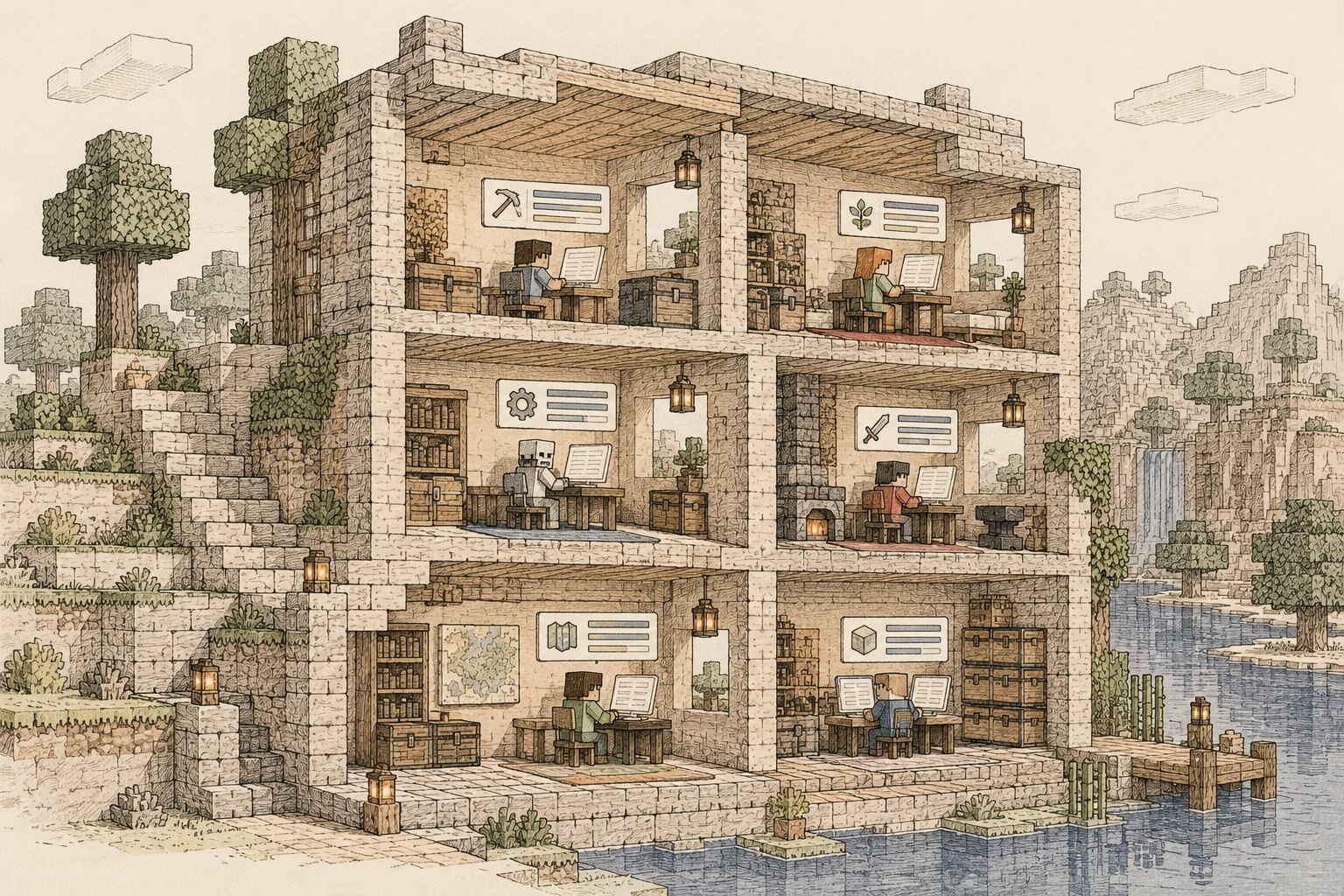
A voxel building cut open: one agent per room, each with a status banner and a screen
One agent, one room. Each agent has its own desk, screen and status, readable from outside the building. Illustration

How it works underneath

Every workspace is a tmux session (a terminal that keeps running in the background) on your own PC. A small bridge, listening only on your machine, draws those sessions onto in-game screens and sends your keystrokes back11.

Minecraft world computers · walls lamps · web screens WHAT YOU SEE omo-bridge your machine only your PC tmux workspaces Hermes · Claude Code files · web · tools WHERE THE WORK HAPPENS keys screens
The game is only the view. Closing, leaving or crashing Minecraft does not touch the sessions on the right.

Three design rules

  1. Leaving changes nothingClosing a screen, walking away or quitting Minecraft never stops a process12.
  2. State is reported honestlyIf the session server stops, the screen says INTERRUPTED. Nothing re-runs by itself: “Revive shell” and “Resume Hermes” are buttons you press11.
  3. Idle agents sleepAn agent tab that is idle and unseen for 20 minutes exits cleanly and wakes when a screen shows it again11.
114workspaces known to the bridge
62live sessions
22separate agent profiles
29 Octmeasured read-only on the builder’s machine
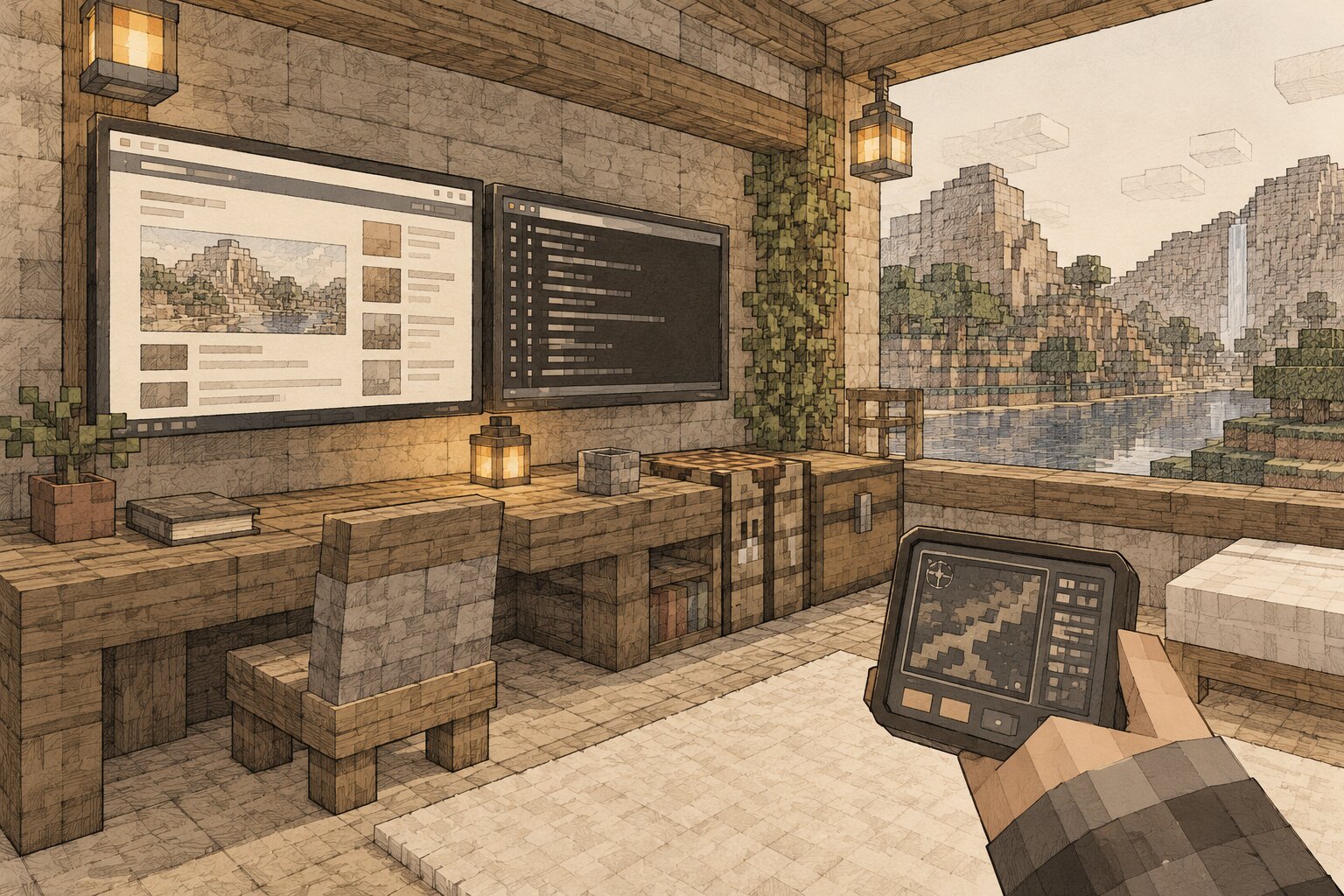
First-person view: a live web page and a terminal on wall monitors, a pocket computer in hand
The wall is the screen. A live web page and a real terminal on in-world monitors, and a pocket computer you carry. Illustration

Some agents have bodies

A separate project adds a Minecraft player named OMO to the same world. You speak out loud, a voice model hands the job to an agent “brain”, and the brain moves the body through 22 tools13. Two robots, a Microduck and an RP1 humanoid, are physics-simulated in the world and come when called by voice.

terminal→wall→avatar→simulated robot

A ladder of embodiment. This paper focuses on the first rungs, where the evidence is strongest.
3 · Method

Five days, live on stream

From 25 to 29 October 2026 the builder used Omo Space as his main workspace while streaming live. He ran a real content pipeline from inside the game: ideas, references, recording requirements, editing, publishing and analytics, each in its own room14.

7stream recordings,
about 29 hours read
8readers, each reading
one chunk in full
791quotes pulled out
with timestamps
791 / 791found word for word
by a checking script

The recordings had already been transcribed by an in-house clipping pipeline (Whisper, small model). Each chunk was read in full by a separate language-model reader, which pulled out claims, quotes, live demos, failures and guest reactions. Claims were then grouped by hand and counted across the eight chunks. A script confirmed that every extracted quote appears in the transcript within three minutes of its timestamp.

A second user, new to Hermes and on Windows, set up his own world from the repository and joined the stream by voice. His account is self-reported.

What this method is, and is notIt is a field study of one builder (an autoethnography) plus one second user. It is good at showing what the interface does in real, messy use. It cannot tell us whether rooms beat tabs for people in general.
4 · Findings

Four spatial moves

Seven themes came up in at least seven of the eight chunks. Four of them describe what space does for agent work. We call them moves.

remember which tab
Find: walk to it
8 of 8 chunks
reopen and re-read
Resume: it’s where you left it
8 of 8 chunks
check every tab
Monitor: look down the hallway
7 of 8 chunks
juggle a to-do list
Orchestrate: walk the pipeline
7 of 8 chunks

Quotes are as transcribed; the speech recogniser sometimes garbles names.

Move 1 · 8 of 8 chunks

Find: walk to it

The most repeated claim: people can’t remember tabs, but they can remember rooms.

“Nobody remembers which of the 12 terminal tabs are doing what but you can remember space and rooms … It’s the oldest memory trick out there.”
Stream, 28 Oct 07:1414
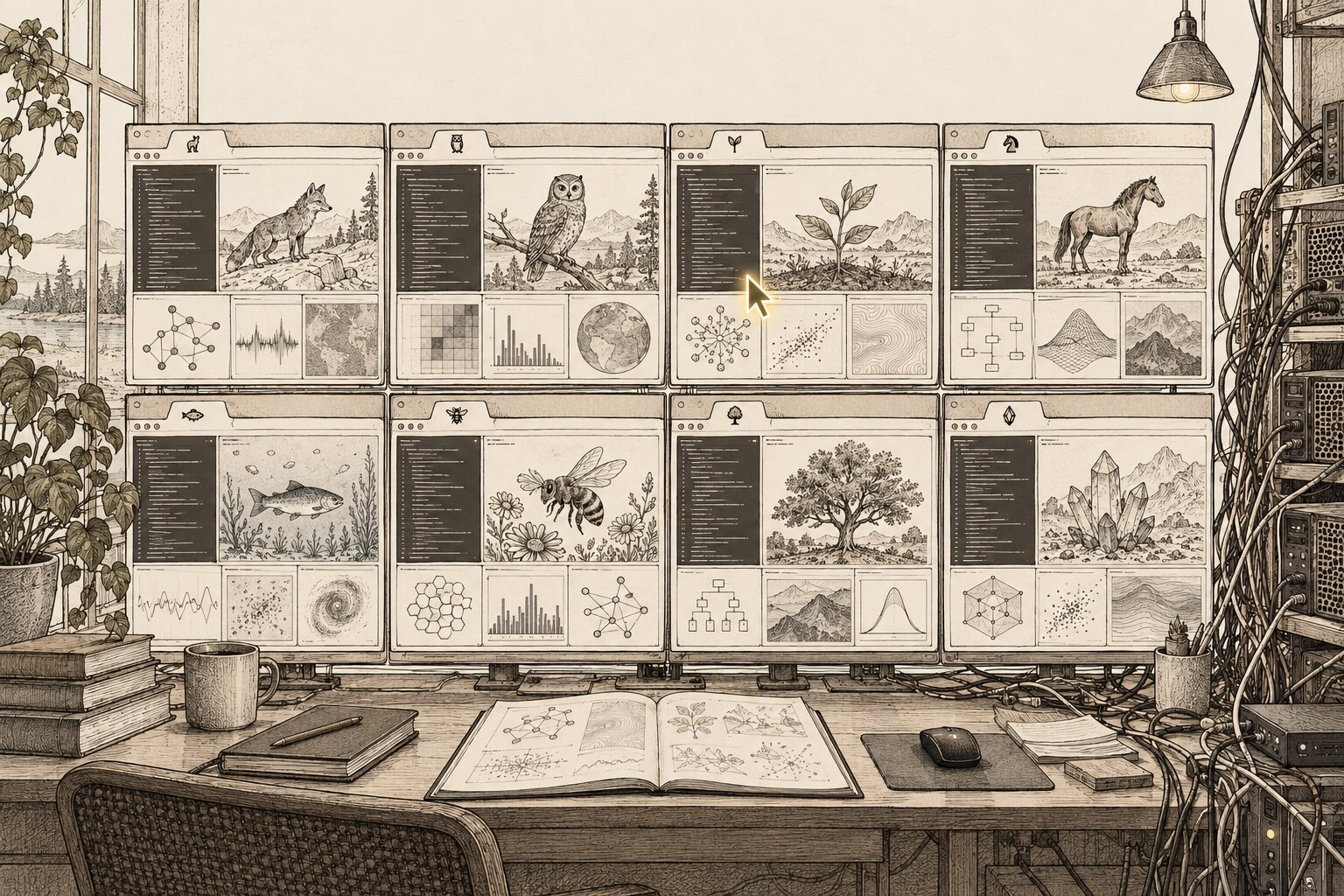
A wall of terminal panes, one per agent, with tangled cables
What it replaces. One pane per agent: tidy on paper, hard to remember in practice. Illustration

This is Data Mountain’s finding2 applied to agents. At peak the builder ran 21 to 25 sessions at once and still described them as manageable.

Move 2 · 8 of 8 chunks

Resume: it’s where you left it

Because the sessions live outside the game, the world is a place you come back to.

“Boom the agents are still working right here.”
Stream, 25 Oct 02:12 · after quitting and reloading the game14

On 29 October, after the PC had been off overnight, the world was exactly where we left off, and agents had edited 22 clips while he slept. In his words: I’m not dreading any pain or context loss14. This matches how people use spatial memory to get back into a task7.

Move 3 · 7 of 8 chunks

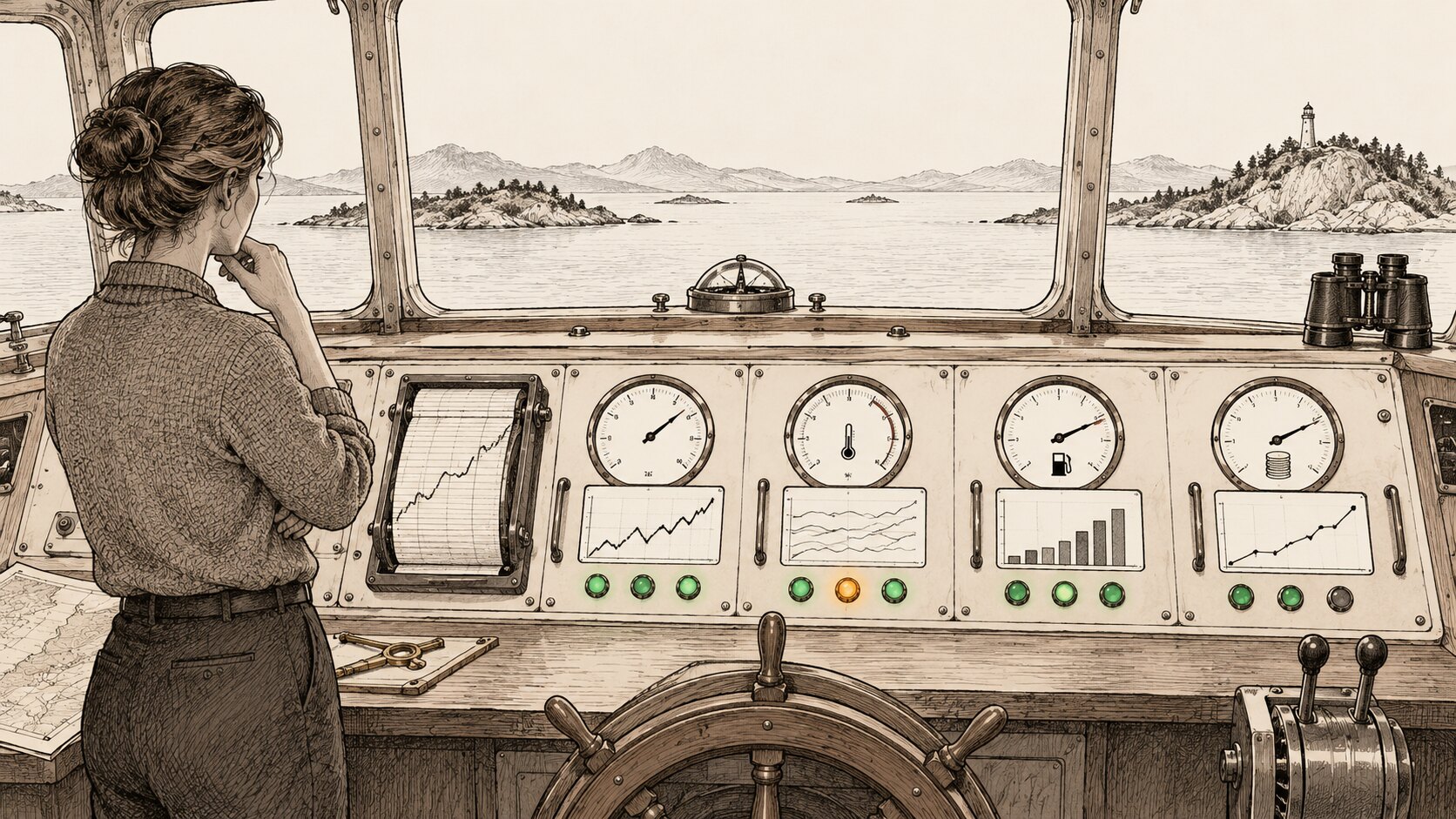
Monitor: look down the hallway

“Every light that you see in there is an agent still working.”
Stream, 28 Oct 00:3614
An observer at a ship-bridge panel of gauges and indicator lamps, one lamp unlit
The glance view. State is read from lamps at a distance, not from a tab. Note the one unlit lamp: you still have to look. Illustration

This is calm technology for agents5. The second user said, without being asked, that watching agents in the world was more fun than watching an AI type in a terminal.

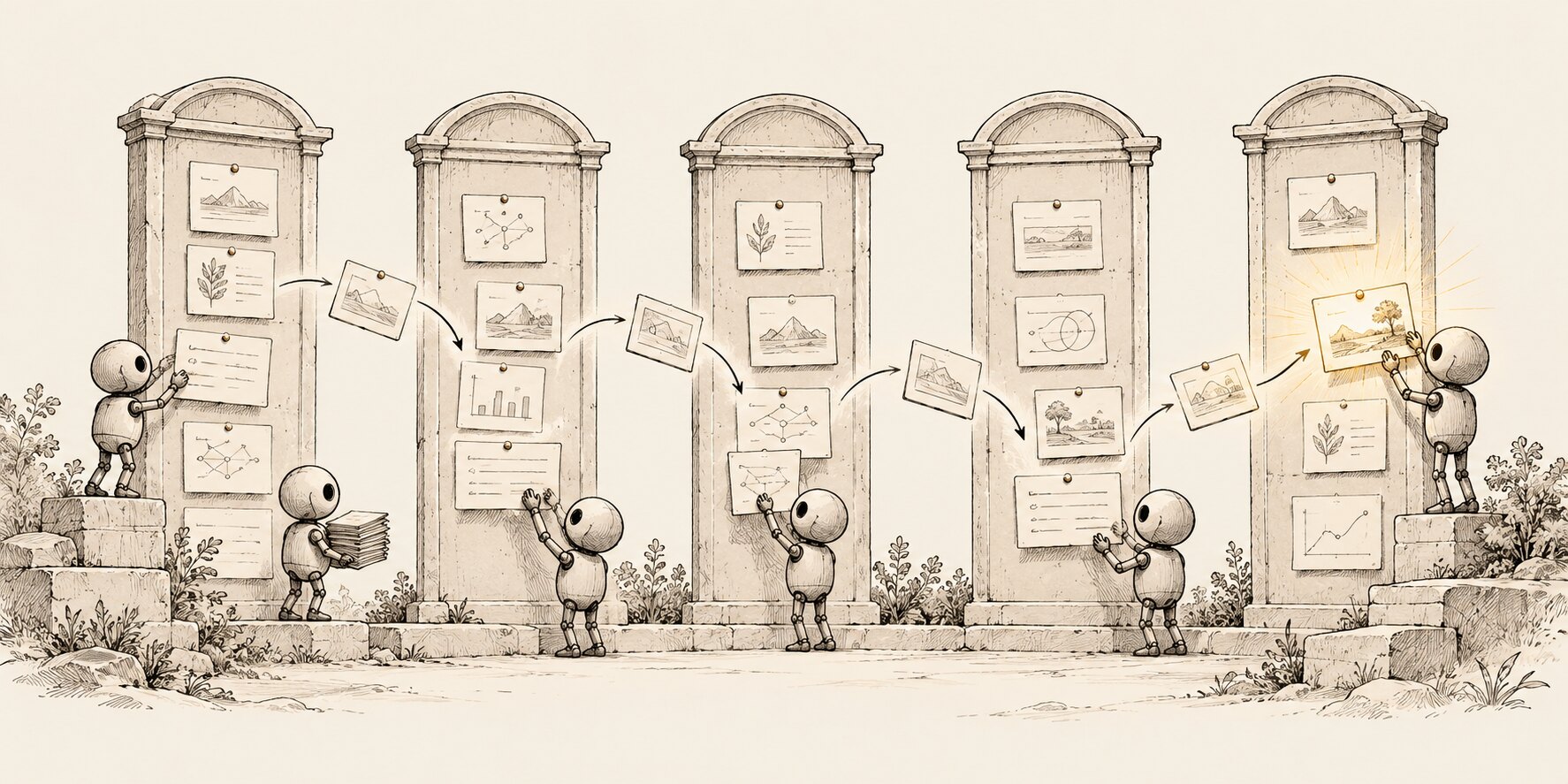
Move 4 · 7 of 8 chunks

Orchestrate: walk the pipeline

The builder’s content business was laid out as a row of rooms: one stage, one agent profile per room.

“We just go to that room and just start building. And when we’re done, then we just leave that room.”
Stream, 25 Oct 01:0414
Small agents passing cards from column to column like rooms in a pipeline
A pipeline you can walk. Work moves from stage to stage, and each stage has its own agents. Illustration

By 29 October he proposed giving every item on his to-do list its own room, calling it a repeatable pattern. The human’s job shrank to reviewing and approving. In the second user’s words: once you press approve inside the game, it just gets posted14.

Two more findings

7 of 8 chunksThe interface is generated, not designed

Rooms were built by agents from a short request: I didn’t build any of this14. When a room costs one prompt, adding structure to your work becomes cheap, and so does throwing it away.

second userIt travelled to someone else

The second user, new to Hermes, built an AI office and a basketball-arena world in about a day and barely had to troubleshoot: It just gave Claude the GitHub. He called the web-page version claustrophobic14.

Spatial interfaces with persistent webpages is easy to use and talk to and control … with this, you can build whatever pipeline that you want.
5 · What broke

The same streams show it failing, on camera

Every failure below points to a design change.14

Crashes

Repeated game crashes, memory exhaustion and two whole-PC freezes. A live “quit and come back” demo crashed. The agent sessions survived; the 3D client often did not.

Keep the work outside the game.
A missed question

An agent asked him something and nothing told him.

A lamp in another room is not a notification.
Who’s listening?

How does it know where I’m talking to? with several voice agents in range.

Speech needs a spatial addressing rule.
A hidden control

The shift-right-click that opens a computer’s setup took two weeks to discover.

Make setup visible.
New kinds of accident

Breaking a block by mistake disconnects that agent. Agents built an unwanted second cave. He sometimes got lost in his own world.

Space brings its own errors.
More is not better

A challenge to post 20 reels in 100 minutes posted zero; later, maybe we’re posting too much.

Measure value, not volume.
Trust

The second user would not use it at his day job because an agent could delete a database. One viewer: Don’t like AI watching.

Permissions before multiplayer.
Self-doubt

He called endless tweaking of the interface a hard addiction; a guest warned him not to get caught in the loop or refining your tools.

The tool is not the work.
6 · Discussion

Five principles for spatial agent interfaces

  1. One agent, one placeGive every long-running agent a stable location and a name you can read from a distance.
  2. The place outlives the viewClosing, leaving or crashing the viewer must never stop the work.
  3. Show state at room scaleWorking, idle and stuck should be visible from the doorway, without reading text.
  4. Be honest about stateNever claim work is running when it isn’t, and never re-run anything on the user’s behalf.
  5. Space is not enough for urgencyAmbient signals need a backup that follows you, such as a sound, a toast or an item in your hand, for questions that can’t wait.

Why Minecraft?

Partly culture: it is already multiplayer, already buildable and familiar to a generation of players. Partly technology: the world itself can be written by agents, which earlier 3D desktops like the Task Gallery could not do3. The cost is a game client that is heavier and less reliable than a terminal.

Limitations
  • One builder and one second user, both enthusiasts. No comparison condition and no measured effect.
  • The builder is also the author and a streamer, so what he says is partly performance.
  • Transcripts come from a small speech model. One line reads “I don’t think Minecraft is superior” and is probably a mistranscription of “I do think”; we leave it out. Some lines are agent-edited video voiceovers he approved, not live speech.
  • Themes were grouped by one analyst with language-model readers, without a second coder.
7 · Future work

A study that could prove it, or not

Each move becomes a hypothesis, tested against an ordinary tab setup (tmux or IDE tabs) with 12 and 24 agents.

H1 · FindFaster to find a named agent

People locate a named agent faster in rooms than in tabs, and the gap grows with the number of agents.

roomsvs tabs · 12 & 24 agents
H2 · ResumeFaster back to work after a break

After a 24-hour break, the time to the first useful action is shorter in the world.

worldvs tabs · after 24 h
H3 · MonitorStuck agents noticed sooner

Lamps and walls beat tab badges for noticing an agent stuck on a question. We expect this to fail when you are in another room, which a backup channel should fix.

lampsvs badges · same room / other room
H4 · BuildOne-prompt rooms are usable

Most rooms built from one prompt are usable without edits. This can be measured from existing agent session logs.

logsno new study needed

Some data already exists: bridge logs of sleep, resume and INTERRUPTED events, per-profile agent session stores, and the stream recordings themselves (walking paths, time spent in each room).

Conclusion

Chat windows were built for one conversation.

Agentic work now means many conversations that keep running when you look away. Giving each one a place, in a world the agents can build for you, turned four chores into four things people already do well.

findingwalkingresumingreturningmonitoringglancingorchestratingvisiting

In five days of real use it held up for its builder and travelled to one other person, and it broke in ways that point to the next design steps. Whether it beats tabs for everyone is the next question. We have laid out how to answer it.

Sources

  1. Henderson & Card (1986). Rooms: the use of multiple virtual workspaces to reduce space contention in a window-based graphical user interface. ACM TOG. dl.acm.org/doi/10.1145/24054.24056“This results in ‘window thrashing,’ in which the user must expend considerable effort to keep desired windows visible.”
  2. Robertson, Czerwinski, Larson et al. (1998). Data Mountain: Using Spatial Memory for Document Management. UIST ’98. microsoft.com/research“Our study demonstrates that the Data Mountain has statistically reliable advantages over the Microsoft Internet Explorer Favorites mechanism…”
  3. Robertson et al. (2000). The Task Gallery: a 3D window manager. CHI ’00. dl.acm.org/doi/10.1145/332040.332482“User studies suggest that the Task Gallery helps with task management, is enjoyable to use, and that the 3D metaphor evokes spatial memory and cognition.”
  4. Malone (1983). How Do People Organize Their Desks? Implications for the Design of Office Information Systems. ACM TOIS. dl.acm.org/doi/10.1145/357423.357430“A very important function of desk organization is to remind the user of things to do…”
  5. Weiser & Brown (1995). Designing Calm Technology. Xerox PARC. calmtech.com“…visible and audible from many offices without being obtrusive.”
  6. Czerwinski, Horvitz & Wilhite (2004). A Diary Study of Task Switching and Interruptions. CHI ’04. microsoft.com/research“…the difficulty of shifting among numerous tasks.”
  7. Ratwani & Trafton. Now, where was I? Examining the Perceptual Processes while Resuming an Interrupted Task. gregtrafton.com“…participants were able to use spatial memory to return to the general area where they were interrupted.”
  8. Wang et al. (2023). Voyager: An Open-Ended Embodied Agent with Large Language Models. arXiv:2305.16291. arxiv.org/abs/2305.16291“…the first LLM-powered embodied lifelong learning agent in Minecraft…”
  9. Park et al. (2023). Generative Agents: Interactive Simulacra of Human Behavior. arXiv:2304.03442. arxiv.org/abs/2304.03442“…we manifest a society of twenty-five agents in a game environment. End users can observe and interact with these agents.”
  10. White, Nottingham, Maniar et al. (2025). Collaborating Action by Action: A Multi-agent LLM Framework for Embodied Reasoning. arXiv:2504.17950. arxiv.org/abs/2504.17950“…the primary bottleneck in collaborating effectively for current state-of-the-art agents is efficient natural language communication…”
  11. Omo Space documentation, Agents and terminals. github.com/omoresearch/omo-space “Nothing is ever re-run without you.”
  12. Omo Space CHANGELOG. github.com/omoresearch/omo-space “Closing a screen, leaving the chunk, quitting the game or restarting the bridge never stops a process.”
  13. Omo, brought to life, README. github.com/omoresearch/omo-brought-to-life “omo-body MCP: 22 tools”
  14. Stream analysis: synthesis of seven streams, 25–29 October 2026 (this study). Per-chunk quotes with timestamps are kept in our study notes. “All 791 extracted quotes were re-checked…”

Illustrations were generated for Omo Research (requested model gpt-image-2.5). They are drawings, not screenshots.
The animated walk-through is a diagram of the idea, not a recording.
Omo Research · working paper, draft · 30 October 2026